How to Steam Milk at Home for Better Lattes
 By groundsandcrema.com Editorial Team · Updated October 7, 2026
How we research: this guide is based on manufacturer specifications, published data and verified customer feedback. Products are not personally tested unless marked “Tested by us”. Our process.
We may earn a commission when you buy through links on this site, at no extra cost to you. As an Amazon Associate I earn from qualifying purchases.
To steam milk at home, you need heat, a little air, and enough movement to turn that air into tiny bubbles. With a steam wand, the goal is glossy microfoam for lattes and cappuccinos. Without a wand, you can still make warm, foamy milk, but the texture will be different.
If you are still choosing gear, the espresso machines guide and best espresso machine for beginners are good starting points. A wand is the easiest path to café-style milk, but it is not the only way to make a good home drink.
Below, you will find the basic wand method, simple workarounds for homes without a steam wand, the most common mistakes, and a few current machine setups that make steaming easier every day.
Quick picks
Comparison table
| Method | What you get | Best for | Main trade-off | Check price |
|---|---|---|---|---|
| Steam wand | Fine, glossy microfoam | Lattes, cappuccinos, latte art | Requires practice and an espresso machine with a wand | — |
| Automatic milk frother | Warm foam with less effort | Beginners and low-fuss drinks | Less control over texture and pourability | — |
| Handheld frother or whisk | Loose foam on top | Quick drinks and budget setups | Not true microfoam | — |
| French press | Foamy milk after heating | A decent workaround at home | Less consistent and usually airier than a wand | — |
Our picks in detail
Breville Bambino Plus (BES500BSS1BUS1)
Best for: Beginners who want automatic milk texturing and fast setup
ThermoJet heats in about 3 seconds, which helps the machine get ready quickly.
The hands-free steam wand is designed for automatic milk texturing and microfoam-friendly results.
The machine uses a 54mm portafilter and an 18 g dose, and it includes automatic purge after steaming.
Verified customer feedback often praises the small footprint, ease of use, and reliable milk frothing; common complaints mention grind/dose sensitivity and occasional frother or tray issues.
- Portafilter
- 54mm
- Dose
- 18 g
- Heat system
- ThermoJet
- Steam wand
- Automatic, hands-free
- Milk purge
- Automatic
Pros
- Easiest path to repeatable milk texture
- Very fast heat-up
- Compact footprint
- Helpful for latte-art style drinks
Cons
- Less manual control than a traditional wand
- Can be sensitive to grind and dose adjustments
- Some owners report occasional frother or tray problems
Breville Bambino (BES450BSS1BUS1)
Best for: People who want a compact machine and prefer to learn steaming by hand
ThermoJet heats in about 3 seconds, so the machine is ready quickly.
It uses a manual steam wand, which gives you more control over how much air you add and when you switch to texturing.
The machine uses a 54mm portafilter and an 18 g dose, and it includes hot water through the wand.
It is a good fit if you want the Bambino footprint but do not need automatic milk texturing.
- Portafilter
- 54mm
- Dose
- 18 g
- Heat system
- ThermoJet
- Steam wand
- Manual
- Hot water
- Via the wand
Pros
- Manual control over milk texture
- Fast heat-up
- Compact and simple workflow
- Good choice for practicing technique
Cons
- Requires more learning than the Plus version
- Less convenient if you want one-touch milk texturing
- You have to manage steaming and cleanup yourself
Breville BES450BSS Bambino Espresso Machine, Brushed Stainless Steel
Best for: Users who want compact automatic milk texturing
Automatic steam wand for microfoam milk texturing.
ThermoJet heating system reaches extraction temperature in 3 seconds.
Low-pressure pre-infusion and PID temperature control help support the brewing workflow.
It uses a 54 mm portafilter, 1560 W, and 110–120 V.
- Steam wand
- Automatic microfoam texturing
- Heat system
- ThermoJet
- Heat-up
- 3 seconds to extraction temperature
- Pre-infusion
- Low-pressure
- Temperature control
- PID
- Portafilter
- 54 mm
- Power
- 1560 W
- Voltage
- 110–120 V
Pros
- Automatic steam wand simplifies milk texturing
- Very fast heat-up
- Low-pressure pre-infusion and PID temperature control
- Compact 54 mm portafilter workflow
Cons
- Automatic wand offers less manual control than a traditional wand
- Less hands-on than a fully manual steaming setup
Gaggia RI9380/46 E24 Espresso Machine, Brushed Stainless Steel
Best for: Home baristas who want a classic manual single-boiler setup
Made in Italy.
Single-boiler/dual-use boiler with 3.5 oz boiler capacity.
58 mm stainless steel portafilter and commercial-style steam wand with a 2-hole tip.
72 oz water reservoir, 15 bar Italian-made pump, and 9 bar OPV calibration.
- Origin
- Made in Italy
- Boiler
- Single-boiler/dual-use boiler, 3.5 oz capacity
- Portafilter
- 58 mm stainless steel
- Steam wand
- Commercial-style, 2-hole tip
- Reservoir
- 72 oz
- Pump
- 15 bar Italian-made pump
- OPV
- 9 bar calibration
Pros
- Classic manual workflow
- Commercial-style steam wand
- Large water reservoir
- Made in Italy
Cons
- Single-boiler workflow requires more timing
- Needs more temperature management than simpler machines
What steaming milk actually means
Steaming milk is not just heating it. You are adding a controlled amount of air and then spinning the milk so the bubbles get tiny and the texture turns glossy. That is what gives lattes and cappuccinos their silky mouthfeel.
A steam wand is the best tool for true microfoam. Frothers, whisks, and French presses can still make foam, but the texture is looser and usually less pourable. If you want café-style results more often, a wand is the most reliable route.
- Latte goal: smooth, shiny milk with very small bubbles
- Cappuccino goal: a little more air, but still fine-textured
- If you do not have a wand, you can still make a good hot milk drink
- Start with cold milk for the easiest control
How to steam milk with a steam wand
Follow the same basic order every time: purge, stretch, texture, finish, and clean. That routine helps you avoid watery milk, giant bubbles, and burned flavor.
1. Fill the pitcher and purge the wand
Use cold milk and a small stainless pitcher. Leave room for the milk to expand, because steaming adds volume. A pitcher that is only part full is usually easier to control than an oversized one.
Before the pitcher goes under the wand, purge the wand briefly to clear out condensed water. That first burst should go into a towel or drip tray, not into your milk.
2. Stretch the milk with just a little air
Put the tip just under the milk surface so the steam pulls in a small amount of air. You want a gentle tearing sound, not a loud scream. If the wand is too high, the milk will fill with big bubbles.
For latte milk, keep this phase short. For cappuccinos, you can add a little more air, but the bubbles should still be tiny and integrated rather than dry and foamy.
3. Texture the milk until it turns glossy
Lower the pitcher so the wand tip sits a bit deeper and the milk begins to spin in a smooth whirlpool. This motion breaks up the larger bubbles and gives the milk that shiny, paint-like look.
Stop when the pitcher feels very warm and the milk looks smooth. Breville’s manual lists finished milk around 140-149°F (60-65°C); if your machine gives its own target, follow that instead.
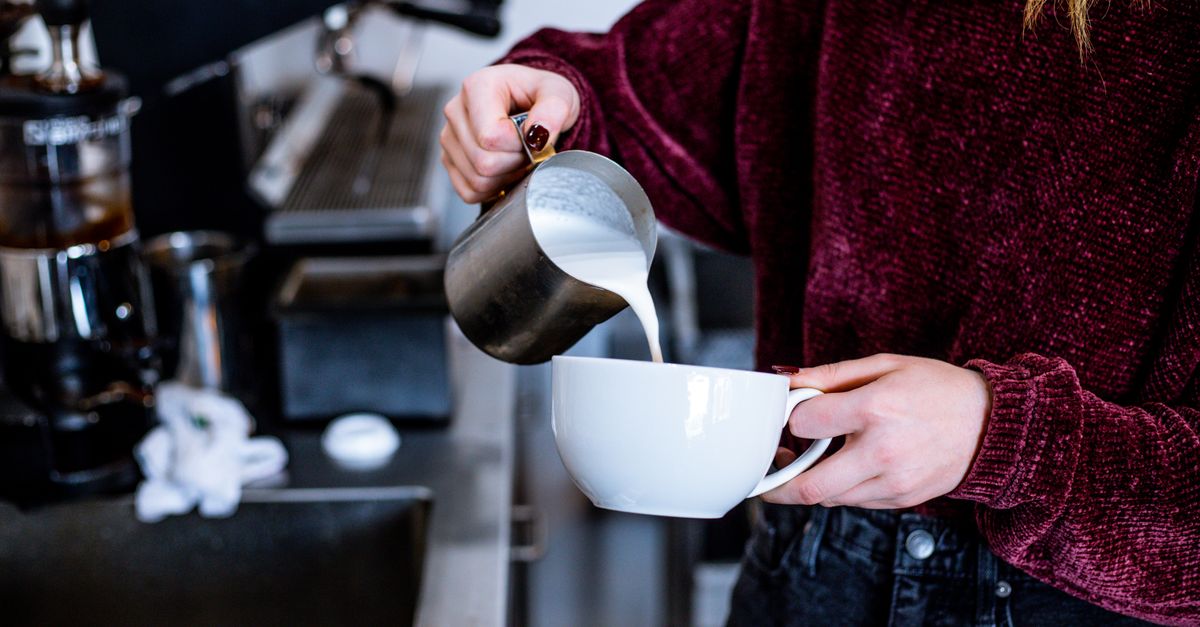
4. Polish the milk and pour immediately
Tap the pitcher lightly on the counter if you see a few stubborn bubbles, then swirl again. The goal is a glossy surface with a tight texture, not a stiff foam cap.
Pour right away so the foam does not separate. If the espresso tastes off, how to dial in espresso will help the drink overall, because milk can only cover so much.
Best setups for steaming milk at home
If steaming milk is your main goal, the right machine matters more than an extra brew preset. Automatic wands are easiest, manual wands give you more control, and single-boiler machines ask for a little more technique.
If you want the most convenient route, the Breville Bambino Plus is the simplest of the current options here. If you want a compact machine with automatic milk texturing, the Breville BES450BSS Bambino Espresso Machine, Brushed Stainless Steel gives you another quick-heating choice. The Breville Bambino (BES450BSS1BUS1) and Gaggia RI9380/46 E24 Espresso Machine, Brushed Stainless Steel put more of the work in your hands.
- Breville Bambino Plus (BES500BSS1BUS1): automatic steam wand, automatic purge, and fast heat-up for users who want consistent microfoam.
- Breville BES450BSS Bambino Espresso Machine, Brushed Stainless Steel: automatic steam wand, ThermoJet heating system, low-pressure pre-infusion, and PID temperature control.
- Breville Bambino (BES450BSS1BUS1): manual steam wand and fast heat-up for users who want more hands-on control.
- Gaggia RI9380/46 E24 Espresso Machine, Brushed Stainless Steel: Made in Italy, 58 mm stainless steel portafilter, and a commercial-style steam wand with a 2-hole tip.
How to steam milk without a steam wand
No steam wand? You can still heat and foam milk, but it helps to be honest about the trade-off: these methods make a good drink, not true microfoam. They are fine for casual café-style drinks, hot chocolate, or a quick latte-like mug at home.
If you are shopping for a machine with a wand, the right entry-level model matters more than a fancy trick. Compare options in the best espresso machine for beginners guide or, if you want to stay more budget-conscious, the budget espresso machine guide can help you compare entry-level options.
Automatic frother
An automatic frother is the easiest option if you want one-button convenience. It heats and aerates the milk for you, which reduces the learning curve.
The result is usually lighter and less silky than a steam wand, but it is repeatable and beginner-friendly.
- Best for low-effort drinks
- Good if texture matters less than convenience
- Usually not ideal for latte art
Handheld frother or whisk
A handheld frother or a simple whisk is a quick workaround for hot milk with foam on top. It is cheap, fast, and easy to store.
The bubbles tend to be larger, though, so it will not behave like steamed milk from a wand.
- Best for occasional use
- Works well for a foamy top
- Not a microfoam solution
French press
Heat the milk separately, then pump the plunger to add air. This can make respectable foam if you do it gently and leave room for the milk to expand.
It still will not match a steam wand for texture, but it is one of the better no-wand methods if you already own the gear.
- Useful if you already own a French press
- Better than a jar-shake for consistency
- Still not the same as wand-steamed milk
Common steaming mistakes and how to fix them
Most bad steamed milk comes from too much air, too little movement, or overheating. The good news is that each problem has a fairly simple fix once you know what to listen for and what the milk should look like.
- Big bubbles: the wand tip is too high or you are stretching too long
- Flat, thin milk: you buried the tip too early and never added enough air
- No whirlpool: tilt the pitcher until the milk spins smoothly
- Dry foam that spoons off the top: too much air or too much heat
- Milk separates before pouring: wait less time between steaming and serving
- A sputtering wand: purge before and after each use
What milk and gear make steaming easier
The simplest way to improve milk texture is to make the workflow easier. A small stainless pitcher, a clean wand, and fresh cold milk matter more than fancy tricks.
A machine with a reachable wand and fast heat recovery is easier to live with than one that fights you every morning. If you are comparing accessories or setup pieces, the coffee gear section is a useful place to start.
- Whole milk is usually the easiest to steam into silky foam
- Lower-fat milk can make a drier, airier texture
- Barista-style oat milk is often the most forgiving non-dairy choice
- A small pitcher is easier to control for one drink
- A narrow spout helps with a cleaner pour
Safety and cleanup
Steam is hot, and the pitcher and wand can stay hot after you stop. Keep your hands clear, aim the wand away from anything that can burn, and never leave the machine running unattended.
Purge the wand before and after steaming, wipe it with a damp cloth, and clean up milk immediately. Follow the manufacturer’s manual for descaling chemicals and cleaning steps. If your machine gives a milk-temperature target, use that as your guide.
- Do not overfill the pitcher
- Do not let milk sit on the wand after use
- Keep utensils and hands away from the steam jet
- Unplug the machine before deeper cleaning
- Keep the machine away from sink splashes and standing water
FAQ
Can you steam milk without a steam wand?
Yes, you can heat and froth milk with a handheld frother, French press, or automatic frother. Those methods make a useful home drink, but they do not create the same fine, glossy microfoam as a steam wand.
What milk steams best?
Whole milk is the easiest place to start because it usually makes rich, stable foam. Among non-dairy options, barista-style oat milk is often the most forgiving choice.
How hot should steamed milk be?
Hot enough to drink comfortably, but not boiling. Many machines aim around 140-149°F (60-65°C); if your machine gives a target, follow its instructions.
Should I steam milk before or after espresso?
Usually after you pull the shot, so the espresso and milk go together while both are fresh. That sequence also gives you a better chance of pouring the drink at the right temperature and texture.
Why does my milk get big bubbles?
The wand tip is usually too high in the surface, or you are adding air for too long. Start with a brief stretch, then lower the tip so the milk spins and the bubbles get smaller.
What is the easiest way for a beginner?
Use cold milk, a small pitcher, and either an automatic wand or a very simple manual wand. Start with one drink at a time so you can focus on the sound and movement of the milk.
The bottom line
For true café-style milk, the formula is simple: start cold, add a little air early, spin the milk until it turns glossy, and pour right away.
If that sounds like more than you need, a frother will still make a perfectly good home drink. If you want the best long-term setup, prioritize a machine with a steam wand and compare your options before you buy.
Reader experiences
Own one of these? Your experience helps other readers decide.